.svg)

Start Date / Time
Tuesday, May 26, 2026
12:00 pm
End Date / Time
Tuesday, May 26, 2026
1:00 pm
.png)
Duration
1 hour

Location
Via Zoom
Register hereDescription
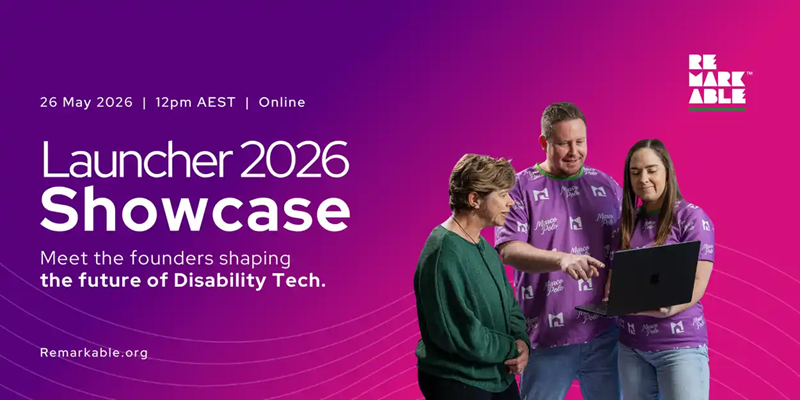
Over twelve weeks, these founders have been testing, validating and building their Disability Tech startups. At the Showcase, they'll take the spotlight to deliver their elevator pitch. Don't miss your chance to discover the next wave of Disability Tech innovation.
We had more than 150 applications for Launcher 2026, and we picked 42 startups. Founders based across Australia, Canada, China, Singapore and the United States.
60% of our founders have lived experience, bringing that perspective directly to the problems they're solving. And their work spans the full range of Disability Tech — from off-road wheelchairs and adaptive underwear, to NDIS navigation and compliance tools, collaborative therapy platforms, AI-powered robotic arms, real-time sensory environment mapping, and a musical communication tool for people with aphasia.
Remarkable Launcher 2026 Showcase Transcript
Date: 26 March 2026
Playing: Remarkable Decade of Impact Video
Voiceover: Pete Horsley
It all began with a simple belief that technology could and should help everyone live the kind of life they want to live. That innovation could open doors, that inclusion could be designed into every line of code, every product, every company. And we set out to find the builders, the dreamers, the founders with the courage to recognise that disability has always been a driver of innovation. It's a living reminder that necessity is truly the mother of all invention. Together, we've helped make therapy more playful and engaging. We've made connection and care feel like family, and we've redefined beauty, fashion, and style to include everyone. We've helped people move, we've helped people learn, work, and live with greater freedom. We've created spaces where belonging isn't just an invitation, it's a benchmark, and we've seen technology open worlds, from classrooms to board rooms, from beaches to mountain trails, and through it all, we've witnessed what happens when innovation meets inclusion. 10 years, hundreds of startups, thousands of lives impacted, and millions more yet to be changed. This isn't just the story of a decade of impact; it's the story of people and bold ideas and collective belief, because this story, it's not just about us, it's about all of us together. We are Remarkable.
Pete Horsley
Good afternoon, everyone. I'm Pete Horsley, founder of Remarkable, and it gives me great pleasure to welcome you. And so good to see where you're all dialing in from. And for those who are watching this recording later on as well, we welcome you as well. For those who are new to Remarkable Australia, Remarkable is Australia's Disability Technology Accelerator, part of the Cerebral Palsy Alliance, and over the last 10 years, Remarkable has backed more than 200 startups building technology that works for the 1.8 5 million people globally living. With disability, we believe that disability isn't niche. This is one of the most consequential emerging technology categories in technology right now, and the founders that you meet this afternoon are really proving that. Now, none of this happens alone, and so I want to start by acknowledging, as well, two of our supporting organisations who helped make Launcher possible. To TPG Telecom Foundation, thank you. Your support of Launcher reflects something we believe deeply in. It's Remarkable that connectivity, communication, and inclusion are inseparable, and you've been there since the beginning of Launcher, and that's the kind of partnership that changes the future ones that exist and persist and continue on. Also to Innovation Victoria, formerly known as LaunchVic. Thank you for your continued belief in the incredible founders in Victoria that are building this space as well. Your investment in this cohort is the signal that inclusion really does matter, and you'll hear from both of them shortly. To the launch of founders, congratulations, you've done the hard work of taking an idea and turning it into something that's real, something that can actually change lives. You've understood the imperative of deep engagement with people with lived experience, you've tested, you've pivoted, you've rebuilt, you've shown up again and again and again, and that's the work, and we're really proud of you, and you should be really proud of yourselves as well, and as Kath said at the beginning of this call, as well, everyone who's here live, and those listening afterwards, this isn't a passive showcase, you don't just get to sit back and kind of watch from the bleachers. You're not just spectators. Every startup needs support. We always talk about just like it takes a village to raise a child, it takes a village of people to raise a startup as well. So it could be an introduction, an offer of a pilot within your organisation, it could be a potential customer that you can highlight this technology to. It could be capital, it could be a mentoring opportunity, or you could become just an early believer and an encourager of these founders. Listen for where you can lean in. As I said, I believe that this is some of the most consequential technology that we can be developing, and this technology that's being developed right now are going to impact for decades to come, and they're going to be built most likely by some of the people on this screen right now, and you have a role to play in that. So, on behalf of the Remarkable team, I'll just show a quick kind of highlight of the team here. An incredible, small but mighty team: Kath, Oliver, Kate, Zara, Liza, and Molly in the States as well. We are really, really proud of this cohort of Launcher participants, and we can't wait to showcase them to you today, and now back to you, Kath.
Kath Hamilton
Thank you, Pete, our truly Remarkable leader. Alrighty, our Launcher program supports ideas for early-stage startups, making an impact in the lives of people with disability. Over the last 12 weeks, our teams are focused on validations of their problem space, or their solution, or product, they'd access to weekly master classes, coaching sessions, and a community of early stage founders sharing the lessons they've learned along their journeys. The Raku team is simply the facilitator of the skills and hard-won experience of the coaches and presenters over the program. I think all of you coaches, and I know the founders, power that to a level to you for your commitment, generosity, and care. This cohort is from five countries have been our most diverse yet. 41 startups went through the program, and 32 have chosen to share what they're up to today. These other founders are also refining or pivoting their ideas, so there's even more to come. As you'll see, most of our startups are at prototype stage and software products. Founders, it has been my greatest joy to see you grow from these interactions with the coaches, with the knowledge, with each other, to go beyond your personal experience and listen to customers, particularly when that made you uncomfortable. And to our old and new community today, it's usually you who are the transformers. Sure, our founders are the catalyst for disruption and demanding the change we need, they have identified and even built solutions to solve pressing needs, but technology is not the hardest part. Deploying it and embedding adoption into ways of working takes the right organisations with the right commitment, and I know that is some of you on the call today. One LinkedIn connection, one phone call can be the difference in these solutions getting to market over the next 50 minutes or so. See what's possible, be the champions of change to activate these technologies, these bold founders with a few simple actions that really can transform the world we live in. So, get into that form, tell us what's useful about these products. In the chat, and keep your fingers on those emojis. All right, friends, let's dig into the remarkable startups, how they're actually getting this done. Don't forget, you can turn on your closed captions in the toolbar and switch to gallery view to see those land interpreters and the globe down the down the toolbar. So our first area of impact is:
Impact Area 1: Sensing & Expression
Every person has the capacity to perceive the world and respond to it. For people with sensory communication differences, that gets interrupted not because of them, but because the tools were built for someone else. When you can't make a phone call independently, signal an emergency, or self-advocate, that's a design failure, right. The startups in this group are building technology that adapts to the individual, learning how they communicate and engage, rather than expecting them to adapt to it. And these Remarkable founders, they're at the forefront of using AI to enable that personalisation at scale.
Daivurjnt - Lena Alabbasi
Spectrum Scan offers more insights on light and sound exposure for a given day. The user can see the average light and average sound they've been exposed to, along with their sensory battery that they can use to measure how much energy they have left throughout the day. They can also see the last measured environment that they did, both location and the actual readings, and we also offer more long-term data trends, both in our line graphs here that users can meticulously look through, but also a calendar view where users can see past months and days and see what's going on. We also have a open, we also have a sensory map that we are crowdsourcing with our users, where users can publish their readings for open environments and have others benefit from it. Here, this local bar, the app immediately tells me this place is not suitable for my needs, because it's too loud, but I can see for myself various readings that happened before and advocate for myself if I want to go or not.
Pranox
10 years ago, when my aunt was struggling with her phone, she bursts out. Why can't I just think of what I want to do, and it just happens. Recent AI developments made this possible. The blind and low vision community showed me where this need was the most urgent. Complex apps make everyday tasks difficult with the screen reader, or even if possible. Online groceries to the utmost, what takes minutes for sighted individuals can take hours, if possible at all. That's why I created AppGenie with the screen reader. Users hear one element at a time, while keeping the whole screen in mind. With AppGenie, they just simply say, I wish I had Nuke from Safeway. AppGenie selects the store, finds the right item, asks questions if needed, and adds it to the cart. The user no longer has to burn the app. AppGenie becomes the interface, turning event into action. When people first try AppGenie, they pause, realising what just became possible. Then their eyes light up, and they keep asking, Can you also do this, and this, and this, and this is just the beginning.
Dori Labs - Tom Luong
Imagine answering phone calls at work when you cannot hear. Imagine calling your healthcare provider when you do not speak. Imagine calling your family all by yourself. Imagine no further, because with Dori workspace we're breaking down barriers to employment and communication, so more people can work jobs that depend on the phone. With Dori Call Assist organisations, continue receiving calls like normal. Callers receive a simple SMS link with live captions and text to speech built directly into every conversation with Dori personal phone. People can make and receive phone calls independently with live captions, optional AI assistance, and text to speech. We're making every phone call as clear as a text message, and we're looking for partners to help make communication more accessible for everyone. Oh, and that voice, well, that's mine. We created a Dori voice bank, and it's coming soon.
Junbell
Junbell turns mystical notes into spoken words, someone who can speak and press a few notes and be heard. My best friend lost his voice, and I refused to let his silence be the answer.
Video voiceover: “Are you okay, Daddy? You want to eat? Are you hungry? You want to eat crackers? Do you want to sleep? Doesn't he want to say anything?”
140,000 Australians with aphasia understand everything, feel everything, and can't get it out. Standard AAC substitutes their voice, Junbell restores it. Simple note combinations on any device, their own pre-stroke voice, music reaching parts of the brain that stroke left untouched.
Signal Safe 2.0
Hello, everyone. My name is Isaiah Harvey, creator of Signal Safe, an innovative safety device designed to protect individuals who are hard of hearing or adhere to wearable technology. Signal Safe is a haptic alert walk that provides vibrating emergency modifications when smoke, fire, or carbon monoxide alarms are triggered for many individuals who hear on law. Traditional alarms may go unheard during critical emergencies, especially while sleeping. Sent out shapes are created to bridge that gap and provide an added layer of protection, independence, and a peace of mind for individuals and families. Today, we are seeking support with a feasible study that will help us evaluate product development, using these accessibility standards, manufacturing potential, and community impact. This research is essential to ensure Signal Safe is effective to the people who need it the most. Your support will help move this life-saving innovation of concept to a reality. Together, we can create safer homes and strive for communities for the people of hardly hearing population. Thank you for your consideration.
Kath Hamilton
Let’s see the love for these founders who are mapping the sensory environments, enabling phone calls, speech, and safety alerts. If you work in local government, allied health, or accessibility, these founders need one simple action from you today. Head to the form and let us know how you would champion them. One introduction can change the trajectory of these solutions, so get in there.
Impact Area 2: Prevention and Treatment
Some of the most consequential moments in disability aren't the everyday ones, they're singular, a birth, a diagnosis. The questions these founders are asking is harder than most. What if the right intervention at the right moment could change a life? These pathways are genuinely difficult. Clinical evidence cycles are long and procurement is slow. There's always there's always fewer startups working here, and the ones that do choose it deliberately, because they believe that early intervention will reduce harm, and that they're the ones to build
People Like You
When I was 30, I heard up my disc herniated and burst into my static nerve. I spent five years trying to navigate the world of chronic pain. However, as you can see, this isn't just my story. This is experienced by millions of people every day. The chronic healthcare space has more gaps than your private health cover, and these are some points to illustrate why. After my five year recovery, I decided to go full Mother Teresa and built People Like U dot Help, a chronic pain app to cater to all injuries. In step the remarkable team, and they taught me three invaluable lessons. First, I should focus on my back pain niche. Second, I should continue to strengthen my contributions in the back pain community, and third, I should listen to MVP data and pivot. So, I'm really excited to present to you people like you dot chat, an agentic care team that has your back work in Agile Learning Loops, and I'm really lucky to have a direct line to my target audience. Now, here's where I really need your help. If anyone has connections to academics, lawyers, or pain specialists, please hit me up.
Duper DuDu
Globally, one in 10 babies is born premature in the NICU. Traditional clothes just don't work, forcing regular outfits often dislodges medical lines and unsettles the baby, leaving parents too terrified to even touch their own child. And the father, Irene, a resisted nurse specialising in the NICU for medical staff, these NICU one CS gives you access to all lines and monitors in just three seconds without even lifting the baby. For parents, you can finally bring cute clothes to dress your naked NICU baby, and this simple yet important act will. Be the real start of your parenthood. We enable life-saving kangaroo care proven by the WHO to reduce neonatal mortality by 25%. To partner with us and improve these fragile lives, please scan the QR code to connect. Thank you.
Everybaby
Preterm preterm birth kills 1.1 million babies every year, and remains the leading cause of death in children under five. Because current diagnostic tools are still not accurate enough, every baby is a preterm birth diagnostic device that directly measures cervical tissue using electrical impedance. In peer-reviewed clinical publication, we achieved an AUC of 0.92 compared with 0.67 for ultrasound and 0.59 for fetal fibronectin. Our test can also be used from 14 weeks gestation up to six weeks earlier than current methods. The core IP was invented at the University of Sheffield and exclusively licensed to every baby, we hold 18 patents across 10 jurisdictions, and have a conditional approval pathway with the Department of Health, Abu Dhabi. To date, we have secured more than $2 million in non-dilutive funding through grants and strategic partnerships across China, Hong Kong, and Korea. We are raising a $2 million seed round to complete GCC regulatory approval, and deploy our first commercial units in the region. At Every Baby, we believe in saving the future by saving babies. If you would like to support our mission or learn more, please feel free to contact us.
Keeping Labor Safe
Some companies are building rockets to Mars. Some are connecting machines to the brain. At keeping labor safe, we are focused on the first frontier every human life must cross: birth before the first cry, before the first breath. The fetus survives in hypoxia, a low oxygen world once compared by Sir Joseph Barcroft to Mount Everest. When humans climb Everest today, we do not send them alone. We send them with oxygen systems, GPS, weather intelligence, satellite communication, and life-saving digital tools. Yet, in labor wards today, in the final hours before birth, babies are still monitored by technology that began more than 50 years ago. When we miss fetal hypoxia, the cost is not abstract, it can mean brain injury, cerebral palsy, and a family's future changed in minutes. KLS is building the intelligence layer for labor and delivery. We help clinicians understand fetal reserve, whether a baby is coping, compensating, or beginning to fail. This is neuro protection for childbirth. Every baby has already climbed Everest in utero. Our moonshot is to make that journey safer for every mother, every clinician, and every baby.
Kath Hamilton
Wow, what did you think of these founders working to stop harm before it happens? They're more advanced stage in some cases, and their asks range from clinical networks to investment. If any of these ring true to your world, whether you're a clinician, a researcher, or a funder, share what or who you know. The connections you make today could genuinely change lives.
Impact Area 3: Connected Care & Capability
Now, for some of you who have spent years navigating systems that require them to advocate loudly just to be heard, having data that speaks to or for you is an enormous opportunity. The startups in this group are harnessing successful connected care models to give families confidence to act, enable clinicians to see what's actually happening between sessions, and individuals to gain agency over their own progress, rather than waiting to be told. They're transforming care from episodic to continuous, from expert-held to shared, from retrospective to real time, these founders are putting health into the hands of their users.
StepAhead
If you have ever wondered about your child's development and had no answer, Step Ahead was built for you. Every year, about 350,000 babies are born with cerebral palsy, the most common movement disability. However, 80% of those cases go undetected under the age of two, which is the most critical window for movement interventions. Current tools such as checklist binary CDC milestones miss up movement patterns during their windows and fail parents. I know this problem personally. I have a movement disability that went undetected. This shaped my PhD work at Columbia University, and why I want to fix this now. Step ahead is an eye power video analysis tool. Parents record their baby, our computer vision pipeline extract the data, they get plain sight language movement insights tracked over time. We don't replace clinicians, we just give them the data they need. Help us close the gap between the moment a parent first wonders and the moment they have an answer. Thank you.
Myodot
Every 11 minutes in Australia, someone suffers. Stroke with nearly a billion individuals across the globe requiring physical therapy due to motor impairments. By interviewing people going through outpatient rehabilitation, we have found some fundamental flaws and gaps, such as people going through unmonitored home therapy without instant feedback, and clinicians having to visually guess the patient's physical recovery progress, and so I have developed Myodot, which is a complete software and hardware ecosystem, which not just measures your movement but accurately measures your localised neuromuscular activity and provides instant visual and haptic feedback to the patients, resulting in higher motivation and adherence, Myodot also delivers comprehensive single click reports to the clinicians with derived metrics such as neuromuscular efficiency and fatigue, with an objective insight into the neuromuscular recovery progress. Myodot isn't just a concept, it's functional, and the engineering is moving rapidly, and we want to begin our clinical trials with our 15 MVP units in the month of July. Thank you.
Cove
When my son Liam started therapy at six months old, I found myself attempting and failing to fill the shoes of his physical, speech, and occupational therapist in the time between sessions. Professions that require years of treating, but as his mom, I was drowning in guilt, wishing I could keep his incredible team with us all week long. The tools and systems supporting pediatric therapy today start and end with a session, setting families up for failure and putting unfair pressure on therapists to squeeze everything into one hour. Our research shows 87% of pediatric therapists are limited to verbal or written instructions alone. Cove changes that we are not a compliance tool, we are an empowerment platform where therapists extend their expertise beyond the session, families get guidance that flows into the daily rhythms of their routines, and the entire care team stays connected to the same guidance, progress, and journey for therapists, a window into the week, guidance shared in the moments that's needed most, and compensation for the care you're already giving. Our pilot shows stronger momentum, better follow through, and real time back for therapists. Pediatric therapy always deserves this, because support shouldn't be limited to the session?
Hygiene Hippie
I'm Grayson, an occupational therapist, and after four years of working with a client, someone looked at me and said, he doesn't really have any skills, does he? Over 2000 hours of ABA therapy and 27 OT goals meant he had every skill he needed to get a job, but unfortunately I wasn't surprised to hear this, because his story is like so many others that I work with. His story, he worked with 22 different staff members when he was with us, and those staff members didn't have time to create materials to help facilitate that carry over into new environments. And lastly, despite good efforts, his parents had no idea what was happening in the center, and that's why I created Hygiene Hippie. It combines visual schedules and video modeling together, so that you build a routine once for staff members, families, and most importantly, the individual to carry with them everywhere and forever. Our pilot clinics are telling us that this is solving a need that no one else does, so if you know somebody that could benefit from this, a therapy clinic or a clinical director, we'd love an introduction.
Mimbalu
Imagine you're seven years old and it's time to get ready for school, but your clothes prick, time blurs, sound hurts, you're frozen in fear. The next steps aren't clear, and it's not even 8am One in five Aussie kids are neurodivergent. When support arrives, it arrives fragmented, each giving a different framework and completely overwhelming the parent. We spoke to over 420 families, and over 85% reported the same. The problem is not autism or ADHD. The problem is that the tools are fragmented or come in distracting apps on phones and tablets with a significant ongoing admin burden. I'm a nurse of over 14 years and a mum to wonderfully autistic children, and this is my co-founder, Sahil Ya Dav, a mechatronic engineer and software developer. We teamed up with therapists and have developed a world's first offline therapeutic companion out of the box. It runs the child's daily support autonomously. It teaches the adults around them how to do the same from home, school to healthcare, scalable support that works. Our ask today, we are asking for introductions to angel investors, to media, or for you to simply follow our journey on Instagram, and to share what we are building. Thank you.
Kath Hamilton
Go ahead. I know these products touch many of you, so let us know how you feel about them. How. Are putting their clinical expertise directly in the hands of carers, parents, and clinicians. There are some really grounded pilot partners, clinical directors, early adopters, ready to try something new. So, if you manage a practice, run a program, or know someone who does, please let us know in those forms. What looks like a small lead or critical insight to you could be the breakthrough a founder has been waiting for.
Look at these beautiful faces, we mentioned them before, but I want to give another huge shout out to our coaches. Thank you. Every founder in this cohort has had someone in their corner, someone who showed up week after week with hard questions, honest feedback, deep expertise, and genuine care. This year, our coaches are founders, operators, designers, clinicians, and leaders. They've scaled startups themselves, built global teams, and shaped the disability tech sector from the inside. Please join us in celebrating them. The program could not exist with without them. Thank you so much to all of our coaches.
Impact Area 4: Care systems and Navigation.
The system designed to support people with disabilities are too often the largest barrier they face. In Australia, the NDIS alone generates millions of administrative interactions each year, plans, reviews, appeals, and funding decisions. The burden of documentation falls disproportionately on the people with the least capacity to carry them. These startups have found two ways to distribute that empowerment, giving people with disabilities the clarity and tools to navigate the systems that were designed without them, and efficiency, reducing the administrative weight on care workers, so that more of their time reaches the people they care for.
Squidly
Hi, I'm Josh, co-founder and CEO of Squidly, and I'm Gabriel, co-founder and CEO. During COVID, therapy moved online overnight, but for people who use communication devices or eye gaze or support from another person, the call still often wasn't theirs. Parents spoke, support workers clicked, communication often sat another device off the screen. People could join care, but lost privacy, autonomy, and control in return. Squidly changes that, bringing the video, communication supports, accessible controls, and therapy activities all into the one place. Here's Gabriel using Squidly eye gaze to choose and communicate inside the session and on his terms. One early user with Cerebral Palsy said, "For the first time, I can talk with my therapist without someone standing over my shoulder. That's what Squidly is trying to solve - care people can participate in, not just join. Built with the Cerebral Palsy Alliance and people with disability, we're looking for allied health, rehab, and disability partners ready to try Squidly, thanks.
SupportNote AI
It is 10pm Sarah clocks off after a nine hour shift, but she's not done. She opens her laptop and starts writing NDIS progress notes, notes that have to be accurate, have to be complied, have to be right, if they're not her participant, could lose funding hours, and nobody is paying her for this time. I'm Amanda. I work weekends in aged care. I know how hard those long shifts are. I've talked with many independent support workers. The same story keeps coming back. The paperwork is unpaid, it never stops, and it's breaking people who care. So I built SupportNote AI. Workers speak their shift into the app. It writes an NDIS compliant progress note in minutes. Now Sarah gets her evenings back. Two workers are using it now. One told me the program signal slide is amazing. If you know any independent support workers, coordinators, or plan managers? Please introduce me. I wanted to keep building this together with them. Thank you.
Visitex - Mark Gibbs
Hi, I'm Mark, and I've spent years working inside Disability Support, where I saw firsthand just how broken frontline systems really are. The NDIS is a $40 billion sector, but day-to-day support is still run on scattered notes, inconsistent processes in reactive compliance. That means providers lose money, staff burn out, and participants receive inconsistent care. Visitex fixes this. Visitex is a platform. What it is, is in simple terms, we take everything that is currently chaotic and make it structured, consistent, trackable, and the impact is immediate, provided to reduce compliance risk and admin over it. Workers gain clarity and confidence. Participants receive reliable, high-quality care, and once Visitex is embedded, it becomes core infrastructure. Teams rely on it daily. See data builds inside it, and switching becomes extremely difficult. We're not just another tool, we're building the system the sector will run on.
LoveNDIS
Families navigating the NDIS spend hours dealing with paperwork, invoices, and then clear requirements. Review is difficult and often leading to underutilised funding or poor outcomes. So, the solution is LoveNDIS, which is a platform designed to simplify this, it allows families to upload documents, automatically organise and categorise them, and generate structural records aligned with NDIS requirements. Instead of managing scattered information, everything is centralised, trackable, and ready to report, so what makes LoveNDIS different is its focus on the real workflows of NDS participants. It combines intelligent document processing.
PathPlan - Alex
Hey everyone, I'm Alex, and I've been working in the NDIS space for over 10 years. I'm also a parent navigating the scheme for my son, Ethan, and even with everything I know, it is still complex, it's still confronting, and it's still a lot to carry for most people, though it's even harder. The information exists, but it rarely gets translated into something meaningful for the person who needs it, and without that translation, without that context, making truly informed decisions about what to do next is incredibly difficult, and that's why we are building PathPlan. It's a digital platform that guides participants and the people around them with clear information in plain language connected to the person's situation, so they can prepare, navigate, and make informed decisions about what comes next. We are heading toward a mid-year launch, and we are looking for participants or those supporting a participant through NDIS pathways, whether that's access, a review, or home and living. If that's you or someone you know, I'd love to connect. Reach out directly or via the website. All the details are on the screen. Thank you.
What’s Next? - Kristy
Hi, I'm Kristy. I built What's Next? because I was sick and tired of support workers asking me what's next. For example, how I like my toasted cheese sandwich. What cheese? Where the butter goes, and that's just one example. The harder ones are personal to me and critical to my care. Breathing machines, lymphedema wraps every shift, every new worker always me explaining it all over again. That's not frustration, that's exhaustion, that's not being heard. What's next holds the answer. I write the profile, I share it with my workers via a code, no it for them, no clinical care plan required. Workers arrive prepared, relationships build instead of restarting. My voice persists, the energy goes back into my life. I'm looking for founding voices, people with disability who use rotating workers and want to shape this, not just test it. If that's you or someone you know, find me on LinkedIn.
Kath Hamilton
Raise your virtual hands or give me a thumbs up if you've had to fight the system just to access support, these founders are rebuilding the scaffolding of the NDIS and disability care. So, if you're a support worker, coordinator, provider, or have lived experience of navigating the NDIS, please take a moment to connect with these founders. Lived experience shapes better products, and your experience is essential. All right, I'm thrilled to welcome one of our partners, TPG Telecom Foundation, who's been a partner, as Pete said, since 2022 across four launcher cohorts since the very beginning, supporting 137 remarkable startups, and ensuring every single founder gets the access to those amazing coaches we shared before. Danielle Cotter has just stepped into this role, and we're so glad she's here with us today. Please welcome Danielle. We're going to spotlight you up here, I believe. Welcome.
Danielle Cotter
Thank you so much, Kath. And what an incredible journey this has been for all of the participants. It's an absolute pleasure to be here today. This is my first time that I've been here, and to hear from each and every one of you, such innovation has been on display, your creativity, and really looking at what's needed in your communities, so each of you obviously began with an idea, and you so showed such strength and determination over the past 12 weeks, so on behalf. Half of myself, TPG Telecom employees. Congratulations to each and every one of you. You must be so proud, the perseverance that you've shown, and we're really excited to see what's next. So, wishing you all the very best. Thanks, Kath.
Kath Hamilton
Impact Area 5: Mind & Learning
Moving to the education system, it's not designed for people who learn differently. The result is that neurodivergent, anxious, and cognitively diverse learners have been told the problem is them. It isn't. The startups in this group are building new environments where agency, psychological safety, and individual pace are the architecture, not the afterthought. Now, building inside institutions that change slowly is genuinely hard, but these founders, their determination is driven by personal experience. They want to transform the learning for the 20% who have been left out.
Rise Bright
This is my brother, Saverin, and me. We didn't know it then, but we're both neurodivergent. It took his two girls getting diagnosed, and then the rest of us, for us to finally understand why school had always felt so hard. Almost one in five Aussie kids are neurodivergent, that's close to a million children with brains that work differently, and no amount of good teaching in overcrowded classrooms is going to bridge that gap, brilliant, capable kids being let down by a system that wasn't built for them. So, Saverin, his wife, Miranda, and I, we built Rise Bright, an AI-powered tutoring platform that learns each child's neurotype and then adapts around it, not a one size fits all approach, but built for how their brains actually work. And our MVP is already live with 10 families on board in a $3.9 billion industry. No one's built for this yet. We believe every child has brightness within them, and we want to help them rise. We're looking for parents of neurodiverse kids to help shape the future of learning with free pilot spots available at the QR code.
PickleWork
Wait. Was that the lesson? Where do I start? I can't think. I don't remember. A lot of what happens during learning is invisible, and when we can't see it, we often make the wrong inference. Going blank becomes not trying hard enough. Difficulty becomes - I’m not a maths person. Not starting becomes lazy. But the issue might be overwhelm, missing foundations, fear, or simply not knowing how learning works yet. But what if learning could become more visible? What if learners could better understand what's happening and repair how they see themselves as learners? What if we could see meaning forming, see confidence shifting, see learning taking shape over time. PickleWork isn't an LMS, it's a learner support tool designed to help learners understand learning and take ownership of it.
Simplifii
I'm neurodivergent, have invisible disabilities, and I built Simplifii because every retention statistic you're about tears also lit the story I've lived. Australia just legislated the university's accord, which means $40 million a year for outreach. Every reform gets the students through the door, but none of them touch what happens after 8.1% of autistic Australians hold a bachelor's degree. The non-autistic rate is 31.2% The gap is not an access problem, it's a retention problem, and no one has built the infrastructure for it yet. Simplifii OS is a disability tech for the cognitive layer of learning, piloting conversations with RMIT and UNSW. The product is real, the data is building, and the sector tailwind is unmistakable. Every other AI study tool writes for you. Simplifii OS thinks with you. ChatGPT erases your thinking. Notebook LM knows nothing about you. Simplifii OS knows who you are before you even say a word, grounded in your actual documents, and adapts to how your brain works. Every student who stays in is a life that changes. I'm opening up early conversations with aligned angel investors who back retention, not just access. This QR code links you to my live product. Thank you.
Kath Hamilton
Now, I want to see those emojis for anyone who believes that every learner deserves a system designed around them, not the other way around. These founders are looking for schools, families, allied health professionals, and ed tech networks. So, if you're connected to education in any way, tell us what doors you can open. All right, we're getting through them now.
Impact Area 6: Connection & Community
Belonging is a fundamental human need for some people with disability and their families, it's pretty hard to access dual fee care demands, and the invisibility of sharing experience all work against community building, and technology hasn't really served this well. Mainstream platforms really account for what disability experience actually requires. Here's who understands spaces that accommodate difference and connection that doesn't demand performance. These founders are building technology with the people they serve, and they've discovered that belonging is actually something that you can design for.
The Static
What if the advice you need the most could only come from someone who has actually lived it? People with cerebral palsy are often supported, but not always truly understood. That's why I built the Static of three peer mentoring community built by people with cerebral palsy for people with cerebral palsy. Members can find mentors who match their goals, interests, availability, and communication preferences. The Static helps turn connection into momentum with shared goals, check-ins, calls, and starter templates that keep mentoring practical. Visit mentor.clearsignals.com.au
Social Spectrum
Hi everyone, I'm Archana, the founder of Social Spectrum, a platform connecting families of neurodivergent children, so did you know that the hardest part of raising a neurodivergent child isn't always a diagnosis, it's the isolation faced by the child and the family. As a parent to an autistic boy, I have seen these challenges firsthand, where it started with my son not being invited to a birthday party just because he behaved differently, and that's why we are building Social Spectrum, a community platform where families connect with each other and don't feel alone on the journey. Using AI, we do a match and connect feature, and also provide personalised recommendations for resources, events, and journaling. Since our launch, we have now 400 plus families thriving on the app who have participated in more than 30 events online and in person. Our vision is very simple, that no family should navigate neurodiversity alone. Our ask is that we are looking for introductions to disability organisations, schools, and government innovation programs, which can help us pilot and scale Social Spectrum across the communities. Thank you.
LumiCue
When my grandmother was in memory care, what hit us was the quiet. The lively conversations we used to have just gone, replaced by awkward silence. And it turns out I wasn't alone. This is a wound felt by many with loved ones with memory loss. There's a proven approach for this. It's called reminiscence therapy that uses familiar cues, an object, a sound to reach memories that are tucked away. LumiCue brings reminiscence therapy into a daily two minute moment shared between caregiver and those they care for. We call it a spark, one image, one prompt, one sound. A caregiver opens the simple app, reads the prompt, shows the image, plays the sound, and a moment is shared. One tap teaches LumiCue what sparked a memory and what did not. The sparks return on a proven interval, the same spark coming back over days and weeks, rekindling the memory. Every detail is grounded in research from what the card shows to how it speaks to who approves it. LumiCue is the thoughtful app I wish I'd had to connect to my grandmother. Join our wait list to learn more.
Kath Hamilton
Give the founders some love for showing us why belonging matters. These founders are building the spaces that make life richer, and their asks are about reach, finding the communities who need the most, and the advocates who can help spread the word. So, if you're connecting to CP networks, neurodivergent families, or aged care, share how you can activate them. All right, our next partner, LaunchVic, Elle Phillips, is head of startup development at LaunchVic, and for the past two years, their partnership has been a driving force in expanding what's possible for disability tech founders in Victoria. Welcome, Elle.
Elle Phillips
Hey, thanks for having me. Yeah, so we've been supporting Remarkable for a while, and we absolutely love the work that they do, and the work that every one of the founders that's pitched today and previous showcases do as well, so if you haven't heard of us, we're based in Victoria, and our role is really to grow the startup ecosystem here, so not just disability tech, but all tech. But what that means is, if you're ever not sure where to go next as a startup founder, we can hopefully point you to all of the right doors, whether that be from programs like Remarkable Launcher, right through to accelerators, to funding, to investors. My goal is always to connect you with the right people. As Pete mentioned earlier, it would be remiss to me not to mention that our name is currently LaunchVic, but we are in the next couple of weeks going to become Innovation Victoria. It's all the same stuff, we're just merging together with another entity here. In Victoria, called Breakthrough Victoria, but the same support is here, and so you're very welcome to reach out anytime, but yeah, I just wanted to say a huge congratulations to everyone who's gone through the program and pitched today. It's no small feat to take that first step, and you've all done that, so if we could be helpful in you taking the next step from here, reach out anytime. Congrats!
Kath Hamilton
Thanks so much, Elle. We're so grateful for your involvement and the transformation down there in Victoria. We watch with interest.
Impact Area 7: Movement & Autonomy
Okay, we're rounding it out now, folks. Inclusion and independence are compromised by a world that was designed for a permanently able body, but our reality is that physical access can break down across terrains, tasks, and moments like getting outdoors, travelling safely, getting dressed, or even having a beer. Each one is a place that existing technology doesn't reach, cost too much, or just assumes one type of functioning body. But these startups have seized the opportunity to redesign inclusive environments, an accessible physical world, and independence within daily life,
Sticky Aid
Over 1.1 billion people live with an upper body disability, and I can assure you, over 98% of that cohort would struggle significantly to open and apply something as simple as a band aid. First aid packaging and design is tremendously overlooked, and I'm here to change that. The global adhesive band-age market is worth billions, but despite how universal and necessary band-aids are, the design has not changed in decades and remains incredibly non-inclusive. Hi, I'm Emma, a 19 year old founder and Queensland Teen and Business Award winner, and this is Sticky Aid. I was inspired by my granddad, who lives every day with a physical disability. Sticky Aid is a simple dispenser that allows users to apply band aids more efficiently and independently with one hand or just by minimal pressure. We've already built early concepts and gained strong interest, and now we're looking to crowdfunding and investor support to help refine designs, experiment with manufacturing and bring Sticky Aid to life.
UnderWraps Underwear
Let's talk about underwear in Australia. 5.5 million people live with disability, and that's more than one in five of us. When you can't bend, lift your leg, or safely step into underwear, getting dressed can become painful, frustrating, and unsafe. I know this first hand. After multiple orthopedic surgeries, I struggled with something as basic as putting on underwear. I knew there had to be a better way, so I created under wraps underwear, adaptive underwear that looks and feels like everyday underwear, but can be put on standing, sitting, or lying down without bending. Made from soft bamboo elastane, our underwear styles are designed to restore independence, dignity, and comfort with our unique belted front design. The briefs wrap around the body and secure at each side of the waist. As we prepare to launch our range, behind the scenes, we are currently working on period briefs and incontinence briefs for men and women. UnderWraps Underwear will start selling direct to customer through social media avenues, occupational therapists, nurses, and surgeons. Our goal is to enter the overseas markets within the next 12 months, along with pitching to Slade Pharmacies and Chemist Warehouse. We are looking for a cash grant or some seed capital to help us grow. Thank you.
Sielo Robotics
Over 140 million people need daily physical care just to function, and the cost of that care is extremely expensive, over $100,000 a year. Because the aging population is growing so fast, we're projecting that 10 million healthcare worker jobs are going to go unfilled in just the next four years. So, to fix that, we built wheelchair mounted robotic arms that enable users to just live on their own. Our devices cost about $20,000 a unit, which is five times cheaper than competitors. 80% of the cost is already covered by insurance in 14 US states, and we collect 84% gross margins at launch. And users and organisations love and want what we've built. We've signed $440,000 in LO wise for 22 units at a current price point from users and organisations, and have some amazing partnerships to bring this to market. What's really exciting is that as wheelchair users operate our device with joystick and do daily tasks, we're able to collect that data and automate those tasks with AI voice control, but also create the intelligence layer for all future autonomous care robots. We're Sielo Robotics, and we're building the future of physical care. Thank you.
Safe Ride
I've got custody of my granddaughter, Fallon. She's autistic, level three. In the car, she was never. Really comfortable, she was constantly getting out of her seat belt, standing up in the back, climbing onto the parcel shelf at the back of the car, climbing through the console. Once we got involved with Safe Ride, I knew that I wasn't on my own.
Safe Ride brought together families, carers, volunteers, and industry partners to co-design practical solutions. The redesigned harness system for a child seat with a five point harness keeps the release accessible for adults and emergency responders, while remaining out of reach for the child. More than 500 Australian families have already validated the concept. 80-7% preferred the design over a standard harness. We now need introductions to child car seat manufacturers and stage two funding to drive this innovation forward.
Roark Design
Wheelchair users have to transfer all the time, or use a carer or hoist just to get into or out of a wheelchair or car. We're developing products you simply roll onto, accessible for wheelchair users. Our Crikey turns your wheelchair into a motorcycle for urban adventure. Our Magic Carpet turns your wheelchair into a quad bike. When you get there, you just roll off in your own wheelchair independently in seconds. I built these products because everything else made me more disabled. When I finished it, my world got bigger. I just couldn't stop riding it. Imagine being able to do more than if you're able-bodied. That's augmentation, not compensation.
Audacious Pioneers
The world decided physical limitations mean dependence. Well, they're wrong. I'm Stephanie BySouth, the founder of Koti Kart. When I was diagnosed with arthritis, they strapped my legs in steel rods and told me to stay inside. Well, I kept moving. When it's clear skies, and I had support that was fine, but last year I broke another surgery, I couldn't walk, and I couldn't even take out my own washing basket, so I strapped it to a wheel pace and built Kodi cart prototype one, the autonomous hands-free follow me pack to carry the load, and watching commercial warehouses benefit from robotics, I decided to understand whether we could do the same for people like me. The 1000s of questions, a couple of incubators, and thanks to Remarkable Launcher, over the last 12 weeks, we've got 10 trial participants booked, but I need your help. It's a bigger mission than one person can achieve alone, and it has backers and builders to help bring our prototypes to life, and we've got people waiting. So, if you're an engineer, a designer, an investor, or someone who could do with the help to overcome some adversity to being actively independent, please reach out,
Kath Hamilton
Audacious. I love it. Give it up for our last group of founders, who are engineering physical independence. They're asked to cut across clinical trials, manufacturing, and investment. Let us know via the expertise or the connections to build this inclusive world, because it's truly you who are the champions of this transformation?
Okay, are we exhausted or energised? Congratulations to our founders and their teams. These 12 weeks have pushed many of you well outside your comfort zone. You have the qualities that investors chase, partners bet on, and great teams rally behind. It's the main expertise that's earned, not studied, and a visceral personal stake in the outcome, and your ability to bring others with you. Your unfair advantage simply cannot be replicated, because lived experience is your priority insight.
So, our journey continues. You are now and forever part of the Remarkable family, and I look forward to sharing more ways we're going to accelerate your path to market and growth. Thank you again to our coaches, speakers, and our remarkable team for accelerating these Remarkable founders. We can only support so many founders with this caliber of coaches and speakers with the backing of TPG Telecom Foundation and LaunchVic. So, thank you once again.
Now, my friends, I leave you to connect and to build the world together that we can all live in. So, go well, and thank you for joining us today. Loved seeing all of these founders. Please thank them again. Go wild with your emojis. Go well!
Pete Horsley
Thank you so much, everyone. Thank you.
Kath Hamilton
Thanks all.