.svg)
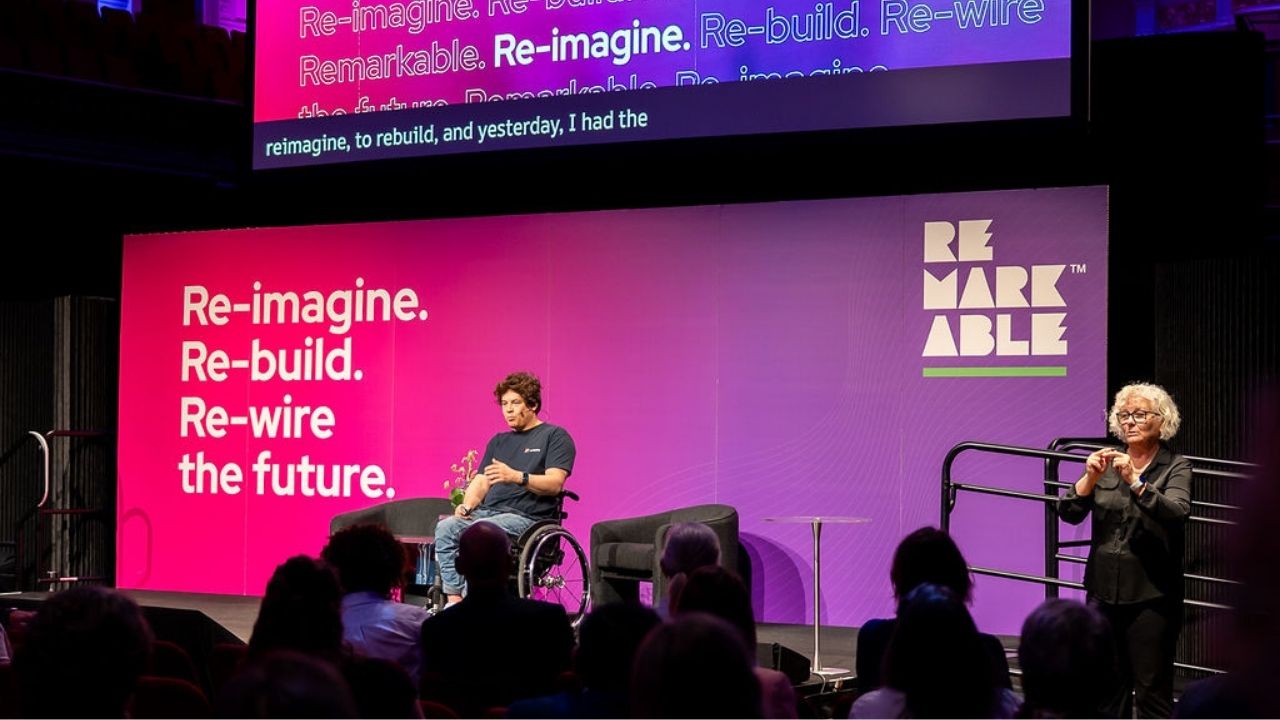
11 November 2025 | Sydney Town Hall
At the 2025 Remarkable Disability Tech Summit, Matt Pierri, Founder and CEO of Sociability, set the tone for the day with a keynote that encouraged us to rethink everything we believe about accessibility. He reframed accessibility not as compliance, but as innovation, inclusion and the foundation of a rewired future.
Grounded in insights and lived experience, Matt’s keynote sparked the conversations that carried through the entire Summit.
Below are five ideas he shared:
1. Accessibility must be reframed, from compliance to inclusion
For too long, accessibility has been treated as a checklist, a risk-mitigation exercise or an afterthought. Matt argued that this mindset not only underserves disabled people, it actively limits innovation.
“We conceptualise accessibility as paperwork, as a checklist … and the problem with conceptualising accessibility as compliance is that it leads to dangerous misconceptions about the whole point of accessibility.”
Instead, he encouraged us to treat accessibility as a design principle that starts with people, not regulations.
2. Accessibility must be functional, not just technically compliant
Matt shared real-world examples of environments that were “compliant” but completely unusable:
- A hotel shower where the soap was a metre and a half out of reach
- A shop with a wheelchair icon but with the doorbell positioned at the top of a set of stairs
- A lift that existed on paper but was out of service
These examples highlighted his key message:
“Merely compliant is insufficient. It is unhelpful to me if I can't do the things I want to do.”
Functionality, not box-ticking, should be the minimum standard.
3. Accessibility is about how people feel
Beyond physical access, Matt highlighted the emotional experience of navigating spaces. His story about being led through a back entrance, past bins and oil spills, to enter a venue captured this perfectly:
“And so I end up inside...(but) I feel like I had been brought in as an afterthought.”
Accessibility should make people feel welcomed, included and respected, not hidden, segregated or treated as an inconvenience.
4. Accessibility is not niche, it impacts all of us
Matt reminded us that disability is the only minority group anyone can join at any time.
- 80% of disabled people acquire disability between age 16 and 64
- 2.5 billion people worldwide need one or more assistive products, according to the World Health Organisation (WHO)
“Accessibility impacts us all, either today or tomorrow.”
This shift in perspective moves accessibility from a “special interest issue” to simply good design for everyone.
5. Accessibility is innovation, not obligation
Matt highlighted that many technologies now seen as mainstream, including the typewriter, telephone and touchscreen, were invented by or for disabled people.
“Accessibility improves access for everybody, and when it becomes mainstream, we just think of it as better design.”
He invited policymakers, founders and organisations to incentivise accessibility and embrace it as a driver of innovation.
Final reflection
Matt’s keynote encouraged all of us to reframe accessibility not as a constraint, but as a pathway to innovation, inclusion and better experiences for everyone.
His call to action was simple:
Move accessibility from the margins to the mainstream and repeat it.
Stay Connected With Remarkable
We hope you enjoyed these highlights. There is so much more we’re excited to share, so stay tuned.
If you would like to stay connected with the Remarkable community, you can:
- Sign up to our newsletter for stories, opportunities and upcoming events
- Follow us on social media for ongoing updates from our founders and partners
Our summit sponsors
Thank you to our generous sponsors who made the Disability Tech Summit 2025 possible.
Image Gallery


.png)
.jpg)